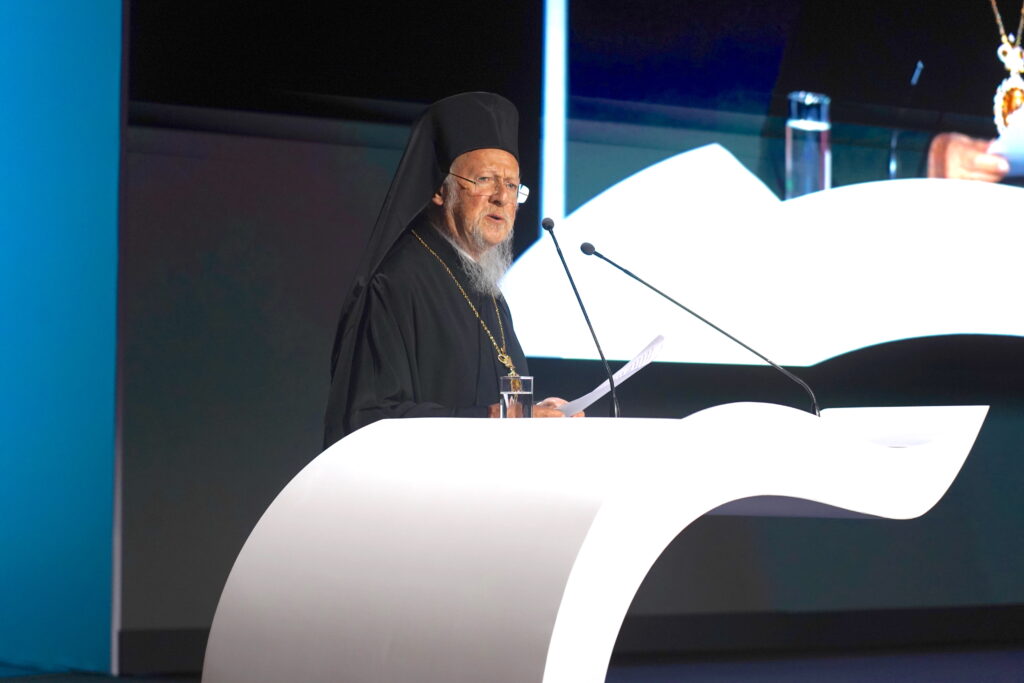
(Prokopion, Cappadocia, June 26, 2010)
Your Beatitudes and Your Eminences,
Beloved hierarchs,
Your Excellency, President of the Panhellenic Union of Cappadocian Societies and their members,
Dear pilgrims to this holy region of Cappadocia,
Our hearts are filled with profound emotion and joy, and we glorify the name of God, who has once again allowed us to realize our pilgrimage to the land of Basil the Great, of the two St. Gregories, those great beacons, and of a countless host of Righteous Fathers, Martyrs and Confessors glorified in this land.
The great sensation of joy that we are experiencing this year is magnified by the presence of the second-in-order Primate of Orthodoxy, His Beatitude Theodoros, Pope and Patriarch of Alexandria, a man who loves the Saints, the Fathers, the Martyrs, and the Greek race. We also have with us: His Beatitude Archbishop Ieronymos of Athens and all Greece, a modest, humble and much-beloved brother in Christ and concelebrant, along with his entourage; His Eminence Metropolitan Hilarion of Volokolamsk, from Moscow; and His Eminence Archbishop Gabriel of Komana, from Paris. Also present is the Panhellenic Union of Cappadocian Societies, which – though a young institution (in existence for only two years) – has accomplished a great deal with immense enthusiasm for the promulgation of the great and exalted spiritual culture of Cappadocia.
Before Christ, Cappadocia did not, as known, have a good reputation in the region. However, from the time of its christianisation, it became known for the deep spiritual cultivation spread of the Gospel through the grace of the Holy Spirit. As a result, it became a unique greenhouse of holiness, where the great Fathers and Illuminators of our Church, myriads of righteous people, along with a great number of Martyrs and Confessors – those evergreen, all-important and fertile blossoms of the Church – were planted and cultivated, flourished and produced fruit, much of which endured for years to come. These include the new Hieromartyr George the Neapolite, St. Arsenios the Righteous the “Hatziefentis,” the holy elder Paisios of the Holy Mountain, the neptic elder Hieronymos of Karvali, and many others. The presence of so many saints produced an ascetic atmosphere and ethos, both in villages and cities, where people fasted strictly, attended services frequently, prayed without ceasing, and fostered humility and patience. They were concerned with spiritual matters and considered heaven as their homeland. They greatly respected the clergy, loved monasticism, and diligently passed on to their children the piety of their ancestors. Even the small number who gave up the Greek language did not cease following their faith, our holy Orthodox faith, or being dedicated to the Greek race and its traditions. The Church saw to the translation and publication of the sacred services into Turkish with Greek characters, the so-called “karamanlidika,” with the result that the full richness of the liturgical tradition was available to all, in order that no soul may be lost.
They were “Romans” in every way, genuine Greek Orthodox Christians, albeit without knowing the language. Thus, the primary surpassed the secondary, and the identity of the people was fully preserved up until the dreadful days of their forced ex-patriotism, which occurred in many places of Cappadocia, such as Sinasson and elsewhere. This was a source of much sincere pain and sorrow for even their Turkish fellow citizens.
St. Basil the Great of Cappadocia, Archbishop of Caesarea – known as the one who “revealed heaven” and as a pillar or cornerstone of the truth, a foundation of the establishment of the Church of Christ and an unsurpassed Theologian, Teacher and Father – is a universal symbol of philanthropy and a living example of the application of the commandments of the Holy Scriptures towards one’s neighbor. A pioneer in organized charity and social welfare, he came to be associated more recently with the joyful carols that children sing during New Year’s celebrations, even if the commercialisation of such holy days in our times do not do him full justice. Nonetheless, that great Saint and friend is in the hearts of innocent children, something which we should make use of, initiating our children in virtue through the example and teaching of this great Hierarch. The decision of the Panhellenic Union of Cappadocian Societies to dedicate its honorary cross to this particular saint and to create it in his name a medallion honoring all those who “by their work promote Hellenism in Cappadocia as the land of the saints, contributing to the preservation of the cultural heritage of contemporary Cappadocians” is indeed praiseworthy. Equally worthy of praise and congratulations is the organization of the present scholarly Seminar on the holy ground of Cappadocia, which we deemed it inconceivable not to attend in person, despite the decision to bestow upon our Modesty the medallion of your organization on the first occasion of this award. Therefore, we wholeheartedly bless your Seminar and every single participant here, as well as the members of your Union and all Cappadocians around the world, wishing you success in your deliberations, but also in your service to Orthodoxy, the Church and the holy “Cappadocian ideals.”
Beloved children in the Lord, continue to remember your roots! Come at the first given opportunity to Cappadocia, alone or with others, to draw from the deep well of piety and dignity of the people who lived there, to be enwrapped in the light of their glorious past, to witness the wounds on the body of the Mother Church and there to contemplate the tides of history with its joys and sorrows, the “glory and dishonor” experienced along the journey of the Greek people, to listen to the mystical sayings of the Saints, their prayers and teachings, to hear the cries and grievances of your fathers, to light a candle in its deserted churches and caves, to pray for the dawn of better days for Greek Orthodoxy! And, above all, teach your children to be authentic Greek Orthodox Christians, Greek Orthodox Cappadocians, worthy of your great heritage, proud of their origins, with an ambition to be surpass their predecessors.
From the depth of our heart, we thank you for the honor of the Golden Cross of St. Basil the Great, which in turn we dedicate to the venerable Mother and Nurturer of us all, the Holy and Great Church of Christ, the Ecumenical Patriarchate, for which Cappadocia was always and remains a select and beloved ecclesiastical eparchy. Through the fervent prayers of St. Basil the Great, may the see of the Church of Constantinople, which holds the First-Throne and principal responsibility, continue to bear its cross with patience and strength, boldly proclaiming Christ to the world, maintaining the Orthodox faith and spirit of the great Cappadocian Fathers, preserving the truth of the Resurrection through the ages, and holding firm the noble and sacred tradition of the Greek race! May you all be well and strong in the Lord, productive in everything you do. And next year, may we gather – in the same place, and in greater numbers – once again in good health.


Watch the historic interview with CBS correspondent Bob Simon now »
Learn More »
Learn the history of the Theological School of Halki since its establishment in 1844. Learn More »
YouTube: Subscribe to the GreenPatriarch channel (on the Environmental Symposia) or the Ecumenical Patriarchate channel (on the US visit).
Thursday, January 12, 2012
The Holy and Sacred Synod convened today, January 10, 2012, under the chairmanship of His All-Holiness Ecumenical Patriarch Bartholomew, for its regular session during which, among other matters, it discussed the issue that has arisen regarding the remand in custody of Fr. Ephraim, Abbot of the Holy Monastery of Vatopedi. Read more...
Please enter a search term to begin your search.