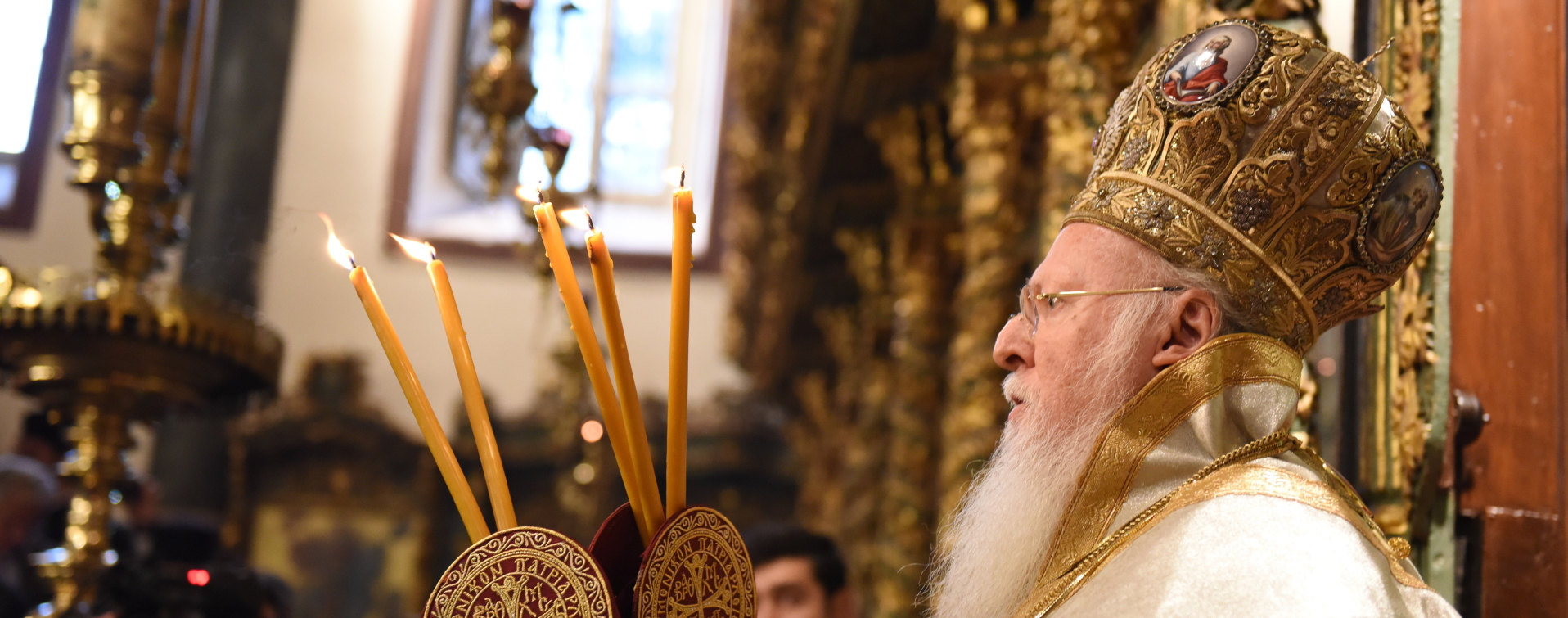
One of the hallmarks of His All Holiness' ministry has been the focus on protecting and preserving God's sacred creation. Under the patronage of Ecumenical Patriarch, the movement known as Religion, Science and the Environment, originally conceived in 1988 on the Isle of Patmos, at a meeting of environmental and religious leaders, out of concern for the water environment of the planet, has organized eight symposia to study the world's main bodies of water. The following symposia have taken place over the past 16 years.
This first of the Symposia, was held as part of the celebration of the 1,900th anniversary of the composition by St John the Theologian of the Book of Revelation, also known as 'The Apocalypse' and the last book of the New Testament of the Christian Bible. The symposium was held aboard the Greek car ferry F/B Preveli that transported participants among the Greek and Turkish ports of Piraeus, Istanbul and Kusadasi. The journey ended on Patmos, the small Aegean island to which St John had been banished from Ephesus. Representatives of the Christian, Muslim, Jewish, Hindu, Buddhist, Jainist, Sikh, Zoroastrian and Bahai religions from 32 countries participated.
The 'Black Sea in Crisis' was the second of a series of symposia on the general theme of 'Religion, Science and the Environment'. An objective of the first symposium was to bring the insights, knowledge, inspirational abilities, and methods of religion and science together to ensure that the natural world on which all life depends is protect- ed from progressive deterioration, while human welfare increases. The second symposium became the natural place to identify specific actions that could be taken, with a particular focus on the Black Sea as a region and environment in crisis. Held under the auspices of Ecumenical Patriarch Bartholomew and Jacques Santer, the European Commission president, the second symposium took place on board the Eleftherios Venizelos. More than 400 participants traveled from the Black Sea ports of Trabzon, Batumi, Novorossiysk, Yalta, Odessa, Constanta, the Danube Delta and Varna, and on to Istanbul. The journey of more than 1,000 nautical miles, through the lands and seas of 2,500 years of Greek colonies and the Roman, Byzantine and Ottoman Empires, ended in Thessaloniki.
The third symposium turned attention to the Danube River at a moment of turbulence, tragedy and new opportunities. Three months after the bombing by NATO, Ecumenical Patriarch Bartholomew spoke on the banks of the Danube at Novi Sad.
The Adriatic Symposium took place June 5-11, 2002, addressed the ethical aspects of the environmental crisis in an area where millions of people live. The six countries of the Adriatic range from a wealthy Member State of the EU to some of the poorest countries in Europe.
The symposium visited an almost entirely enclosed, extremely fragile water body. The Baltic Sea borders on, and receives pollution from, nine countries that have widely disparate natural resources, economies, social structures and mores. The end of the Cold War has allowed the regeneration of political, economic, social, cultural and religious ties within the region. Symposium V called attention to the problems of the Baltic Sea and their causes. The Symposium passed through five countries in eight days, with stops in Gdansk, Kaliningrad, Tallinn, Helsinki and Stockholm and brought together 250 participants - theologians, scientists, policy makers, environmentalists and journalists - under the patronage of the Ecumenical Patriarch and Romano Prodi, president of the EC.
Under the patronage of Ecumenical Patriarch Bartholomew, scientists, politicians and religious leaders went to the frontline of the soya wars in Santarem, Brazil. The symposium coincided with talks in Sao Paolo between soya traders and major UK food companies, which finally delivered a deal to halt the destruction. The Amazon rainforest won a temporary reprieve from an invasion by soya farmers, after Brazil's major traders in the bean agreed to a two-year moratorium on crops from newly deforested land.
His All Holiness, Bishop Sophie Petersen and Cardinal Theodore McCarrick, representing the Orthodox, the Lutheran and the Roman-Catholic churches held a Byzantine prayer service next to Tjohilde's wooden church, on the ancient site where the first baptism in Greenland took place more than 1,000 years ago.
Also taking part were Bishop Andrew Atagotaaluk of the Arctic, Bishop Finn Wagle of Norway, Bishop Jan Lindhardt of Denmark, Bishop Karl Sigurbjörnsson of Reykjavik and Iceland, Cardinal George of Chicago, and Archbishop Roger Schwietz of Anchorage, Alaska. Plenary sessions took place on the "M/S Fram."
Leads the Symposium "The Great Mississippi: Restoring Balance." His All Holiness told the participants in his opening ad- dress that the Mississippi comprises a microcosm of the planet and its waters. He also said that humans have expanded their dominion over nature to the point where absolute limits to our survival are being reached. "We have lost half of the great forests of the world to the demand for timber and for conversion to agriculture, without thinking that these giant wet sponges are responsible for the delivery of much of the fresh water."
For more information, see the official Religion, Science, and the Environment website.


Watch the historic interview with CBS correspondent Bob Simon now »
Learn More »
Learn the history of the Theological School of Halki since its establishment in 1844. Learn More »
YouTube: Subscribe to the GreenPatriarch channel (on the Environmental Symposia) or the Ecumenical Patriarchate channel (on the US visit).
Thursday, May 17, 2012
It is a profound privilege and sincere delight to stand beside other esteemed recipients of the Franklin D. Roosevelt Freedom Awards in order to accept the Freedom of Worship Medal. Read more...
Please enter a search term to begin your search.