

Maximus, also known as Maximus I or Maximus the Cynic, was a cynic
professor and the intrusive bishop of Constantinople in 380, whence he
became a rival of Gregory Nazianzus.
A native of Alexandria of low parentage, he boasted that his family had
produced martyrs. He was instructed in the rudiments of the Christian
faith and received baptism, but sought to combine the Christian
profession with Cynic philosophy. Gregory Nazianzus describes him as
having had no regular occupation, but loitering about in the streets,
like a shameless dog, foul and greedy (kuwn, kuniskoV, amfodwn
uphrethV).
More than once he earned a flogging for his misdeeds and was finally
banished to the Oasis. Later at Corinth, with a high reputation for
religion, he led about a band of females -- "the swan of the flock" --
under colour of devotion (Carm. cxlviii. p. 450). Soon after Gregory
Nazianzus had begun to reside there, Maximus shifted to Constantinople.
Gregory devotes a considerable number of the biting iambics of his
poem, de Vita Sua, to this man, who, however, before long completely
gained his ear and heart.
Maximus professed the most unbounded admiration for Gregory's
discourses, praising them in private and in public. His zeal against
heretics was most fierce and his denunciations of them uncompromising.
The simple-hearted Gregory was completely duped by Maximus, even
delivering a panegyrical oration, in the man's own presence in full
church, before the celebration of the Eucharist, inviting him to stand
by his side and receive the crown of victory.
Meanwhile, Maximus was secretly maturing a plot for ousting his
unsuspicious patron from his throne. He imposed upon the Coptic Pope
Peter II of Alexandria, who lent himself to Maximus's projects. Maximus
found a ready tool in a presbyter of Constantinople envious of
Gregory's talents and popularity (de Vit. p. 13). Others were gained by
bribes. Seven unscrupulous sailors were dispatched from Alexandria to
mix with the people and watch for a favourable opportunity for carrying
out the plot. When all was ripe they were followed by a bevy of
bishops, with secret instructions from the patriarch to consecrate
Maximus.
The conspirators chose a night in when Gregory was confined by illness,
burst into the cathedral, and commenced the consecration. They had set
the Cynic on the archiepiscopal throne and had just begun shearing away
his long curls when the day dawned. The news quickly spread and
everybody rushed to the church. The magistrates appeared with their
officers; Maximus and his consecrators were driven from the cathedral,
and in the tenement of a flute-player the tonsure was completed.
Maximus repaired to Thessalonica to lay his cause before the emperor
Theodosius I. He met with a cold reception from the emperor, who
committed the matter to Ascholius, the much respected bishop of that
city, charging him to refer it to Pope Damasus I. Two letters from
Damasus asked for special care that a Catholic bishop maybe ordained
(Migne, Patr. Lat. xiii. pp. 366-369; Epp. 5, 5, 6).
Maximus returned to Alexandria, and demanded that Peter should assist
him in re-establishing himself at Constantinople. Peter appealed to the
prefect, by whom Maximus was driven out of Egypt. As the death of Peter
and the accession of Pope Timothy I of Alexandria are placed February
14 380, these events must have occurred in 379. When the second
ecumenical council met at Constantinople in 381, Maximus's claim to the
see of Constantinople was unanimously rejected, the last of its
original four canons decreeing "that he neither was nor is a bishop,
nor are they who have been ordained by him in any rank of the clergy"
(Labbe, Concil. ii. 947, 954, 959).
Maximus appealed from the Eastern to the Western church. In the autumn
of 381 a synod held either at Aquileia or at Milan under Ambrose's
presidency considered Maximus's claims. Having only his own
representations to guide them, and there being no question that
Gregory's translation was uncanonical, while the election of Nectarius
was open to grave censure as that of an unbaptized layman, Maximus also
exhibiting letters from Peter the late venerable patriarch, to confirm
his asserted communion with the church of Alexandria, it is not
surprising that the Italian bishops pronounced decidedly in favour of
Maximus and refused to recognize either Gregory or Nectarius. A letter
of Ambrose and his brother-prelates to Theodosius (Ep. xiii. c. i. § 3)
remonstrates against the acts of Nectarius as no rightful bishop, since
the chair of Constantinople belonged to Maximus, whose restoration they
demanded, as well as that a general council of Easterns and Westerns,
to settle the disputed episcopate and that of Antioch, should be held
at Rome.
In 382 a provincial synod held at Rome, having received more accurate
information, finally rejected Maximus's claims (Hefele, Hist. of
Councils, i. pp. 359, 378, 381, Eng. trans.). Jerome tells us that
Maximus sought to strengthen his cause by writing against the Arians,
and presented the work to Gratian at Milan. He appears also to have
written against Gregory, the latter replying in a set of caustic
iambics (Carm. clxviii. p. 250) expressing astonishment at one so
ignorant venturing on a literary composition (Theodoret. H. E. v. 8;
cf. Sozomenus H. E. vii. 9; Greg. Naz. Orat. xxii. xxviii.; Carm. 1 de
Vita sua; Carm. cxlviii.; Tillem. Mem. eccl. ix. 444-456, 501-503.


Watch the historic interview with CBS correspondent Bob Simon now »
Learn More »
Learn the history of the Theological School of Halki since its establishment in 1844. Learn More »
YouTube: Subscribe to the GreenPatriarch channel (on the Environmental Symposia) or the Ecumenical Patriarchate channel (on the US visit).
Thursday, January 12, 2012
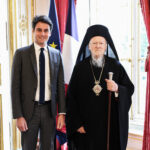
The Holy and Sacred Synod convened today, January 10, 2012, under the chairmanship of His All-Holiness Ecumenical Patriarch Bartholomew, for its regular session during which, among other matters, it discussed the issue that has arisen regarding the remand in custody of Fr. Ephraim, Abbot of the Holy Monastery of Vatopedi. Read more...
Please enter a search term to begin your search.